Always remember to be kind to yourself.
Audio sessions and guided meditations to help you feel calmer, focus more clearly throughout your day, or ease into sleep.
Aromatherapy pairing
Lemongrass or Peppermint
Uplift and sharpen mental alertness
Binaural Beats
Focus
Calm
Sleep
60 BPM Bilateral
70 BPM Bilateral
🎧 Lower your volume before pressing play
Noise Therapy
Sound keeps playing when your device's screen is off
Box Breathing
Tap to learn how to use Box BreathingInhale 4s · Hold 4s
Exhale 4s · Hold 4s
Repeat for 2–3 minutes.
What's happening in your brain
No jargon. No blame. Just the mechanics.
Four parts of your brain got stuck in a circle that feeds itself. It's an injury, not a weakness — and circuits can change.
If you've been through trauma, or you've been in pain a long time, your brain has changed. That's not weakness and it's not in your head. It's a working system that took damage and adapted — the way a knee adapts after an injury.
Here's what changed, and why it feels the way it does.
Why it's worst at 3am
When you're busy, you're mostly alright. The minute you stop, it starts.
So when you say “I'm fine until I sit down” — you're describing something real and measurable.
The smoke alarm
One small part of your brain has a single job: spot danger fast. It doesn't think — it just goes off.
Yours got turned up to maximum, and the dial jammed.
You're not overreacting. The alarm is set too fine.
The filing clerk
Another part does your filing. Every memory gets a date and a place stamped on it, so when it comes back, your body knows: that was then, not now.
Trauma and long-term pain both knock this clerk about. Scans show this part actually gets smaller.
That's why a flashback doesn't feel like remembering. It feels like happening.
The calm supervisor
The front of your brain is the sensible one. Its job is to walk over to the alarm and turn it down.
Here's the cruel part. When the alarm is screaming hardest, this is exactly when the supervisor goes quiet.
That's why “just think about it logically” is useless advice in the middle of it.
The phone line
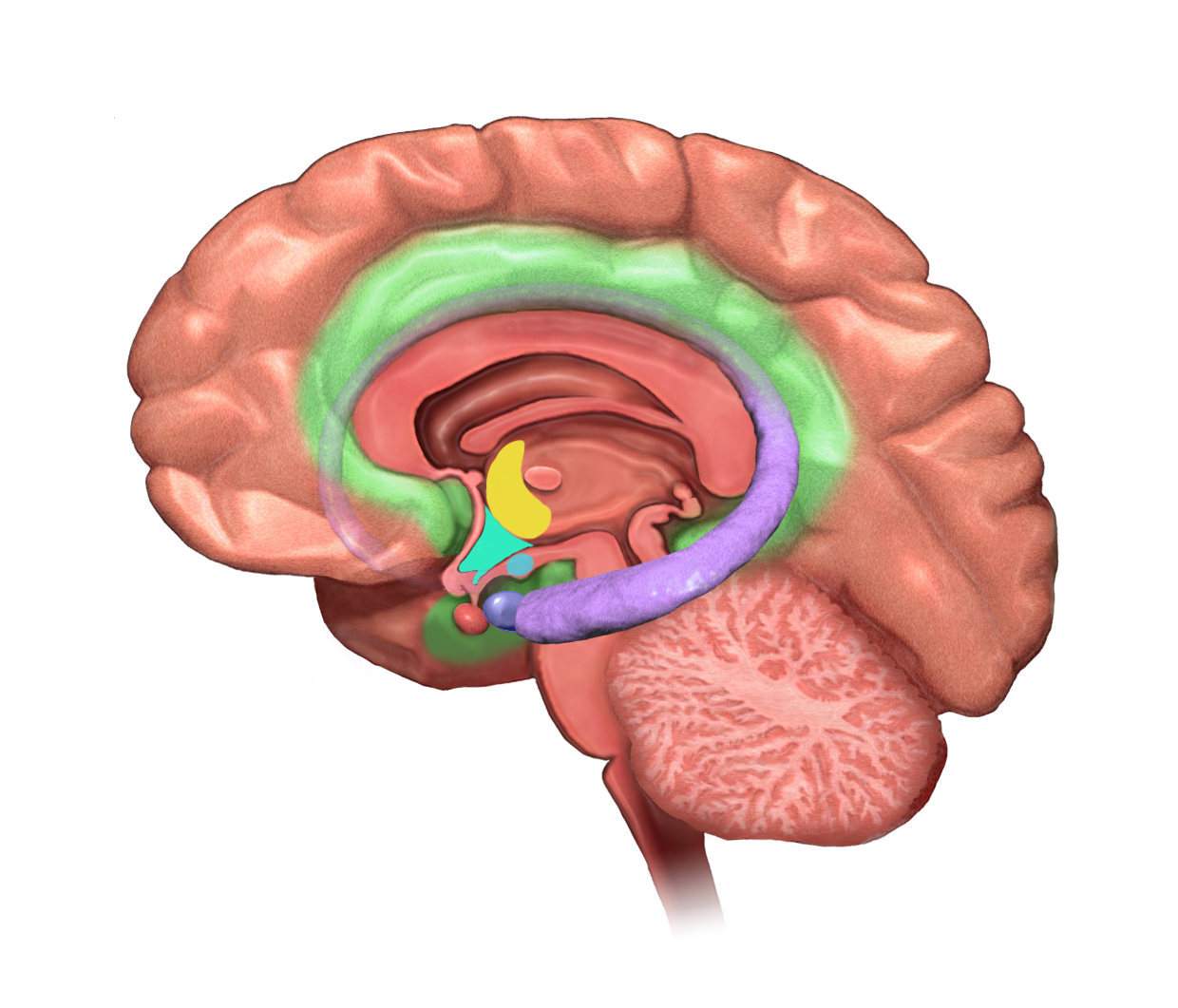
Tap a part below — it’ll light up on the picture too
Illustration: “Blausen 0614 - Limbic system” by Blausen.com staff (2014), CC BY, via Medical gallery of Blausen Medical 2014
None of these parts work alone. They're joined by a bundle of wiring — a phone line running between the alarm, the clerk and the supervisor.
After trauma, that line is changed.
Even if the supervisor came back online and tried to call — the message wouldn't land clean.
The loop
Here's the part nobody explains, and it's the part that matters most.
These four pieces form a circle that feeds itself.
- 1The alarm fires
- 2The clerk can't stamp it “years ago”
- 3The supervisor is offline; the phone line is poor
- 4The body floods with stress chemicals
- 5The alarm reads that as proof it was right
Back to step 1 — fires harder next time
The alarm fires. The clerk can't stamp it “years ago”. The supervisor is offline. The phone line is poor, so the message wouldn't land anyway. Your body floods with stress chemicals — pounding heart, tight chest, ready to run.
And the alarm reads all of that as proof it was right to fire.
So it fires harder next time.
That's the loop. It isn't you failing to get over it. It's a circuit that's wired itself to keep going.
The part that's actually good news
Everything above describes a circuit. Circuits can change.
This is the solid finding, not the hopeful one: trauma-focused therapy reduces symptoms and changes the underlying wiring. The alarm settles. The supervisor comes back. The clerk starts filing again.
The brain that learned this can learn something else.
Where the audio fits — honestly
What this app does, and what it doesn't.
It does not fix your amygdala. It isn't treatment and it won't replace therapy. Anyone telling you a soundtrack cures PTSD is selling something.
What it can do is calm the body enough that the supervisor can get back in the room.
A steadying tool. Something to break the loop at step one, before the body floods. Used alongside real help, not instead of it.
We'd rather undersell this and be straight with you.
Quick check — did it land?
Nine short questions. No clock, no score kept. Pick everything you think is true, then check.
- Open Arms — veterans & families, 24/7 — 1800 011 046
- Lifeline — 13 11 14
- 000 — in an emergency
You're right where you're supposed to be.